Year A – Easter Sunday

Resurrection

(Acts 10:34, 37-43; Col.3:1-4; Jn.20:1-9)

When life is hard, we can find ourselves dragging our feet, doing things only out of a sense of duty or love. And deep down we might carry a sadness, an emptiness, and a feeling that nothing will change.

That’s how Mary Magdalene walks to Jesus’ tomb early on Easter morning. She saw Jesus die on the cross, and accepts that he’s gone. And now, with tears in her eyes, she’s off to anoint his body with funeral spices, to complete a ritual that was cut short by the Sabbath two days earlier.

It’s duty and love that keep her going, but she’s not expecting any miracles.

Now, notice that this is where Easter starts.

We tend to think that Easter begins with celebration and joy, but it actually starts with sadness, confusion, and a tomb. Mary is crying so much that she can’t recognise Jesus, even when he’s standing right there in front of her.

New life has arrived, but she can’t yet see it.

In the movie The Shawshank Redemption, Red (played by Morgan Freeman) leaves prison after decades behind bars. This new freedom frightens him, but he wants to honour a promise he made to a friend. So, he goes to an old oak tree in a field and starts digging. He’s not expecting any miracles; he’s just keeping a promise. And there, hope finds him.

Soon afterwards he’s living a brand-new life on a Mexican shore.

This is how Easter works. Things seem hopeless, and then God surprises us with the most extraordinary blessings. But note that God doesn’t wait for us to sort ourselves out first. He meets us wherever we are, even when life seems empty. Especially when life seems empty.

Mary Magdalene doesn’t discover resurrection because of her faith. She discovers it because God calls her by name: ‘Mary.’ And suddenly the tomb is no longer the end; it’s the beginning, for Jesus and for her.

She becomes the first witness of the Resurrection, and then spends the rest of her life as a messenger, telling everyone: ‘I have seen the Lord.’

Something similar happened to St Ignatius of Loyola in 1521. He was lying on his sick bed, feeling bored, restless and miserable, his right leg shattered by a cannonball. His old life had died, and he’s struggling to cope.

St Ignatius of Loyola

And yet, that’s exactly where God starts something new. Slowly, quietly, and through deep listening and reflection, Ignatius learns that resurrection is not a single moment, but a reorientation of the heart that can happen anytime.

What looked like a sad ending becomes a remarkable new beginning. And he, too, becomes a messenger, sharing the good news.

This is how Easter unfolds.

Mary Magdalene comes to the tomb expecting to grieve. Red goes to the oak tree expecting nothing but a memory. And St Ignatius lies wounded, expecting only pain and despair. In every case, new life is not forced or imagined. It is received. And they go on to share the good news with others.

Mary Magdalene arrives at the tomb

So, what does all this mean for us today?

Many people come to Easter not because they are filled with faith, but because something in them draws them to it. Perhaps it’s memory or habit. Maybe it’s a sense of obligation, or love, or a quiet longing they can’t quite name.

Whatever brings you here, I’d like you to note three things.

Firstly, resurrection doesn’t require you to have a neat and tidy life. Whoever and wherever you are, God loves you. Just be open to him.

Secondly, when resurrection does come, it doesn’t remove your wounds or rewrite history. Mary still knows grief. Red still remembers prison. Ignatius still walks with a limp. Jesus still bears his scars. But none of them are defined by those things anymore.

For death of any kind, including failure, no longer gets the final word.

And finally, both Mary Magdalene and St Ignatius are sent to tell others what they have seen. This doesn’t mean they fully understand (Jn.20:9). Indeed, they don’t have to, because the important thing is that they encounter the living Christ who gives them new life.

As St Ignatius once said, ‘It’s not knowing much, but relishing things inside that satisfies the soul.’

This is the beauty of Easter. But don’t expect to fully understand it, for God’s grace is always a miracle.

Simply be open to encountering the living Christ – who calls us by name and then sends us to carry new life into a struggling world.

Year A – Palm Sunday

From Celebration to Silence

(Is.50:4-7; Phil.2:6-11; Mt.26:14-27:66)

Palm Sunday is designed to challenge us.

We begin Mass by walking, singing, waving palm leaves and chanting: ‘Hosanna to the Son of David!’ Then we find ourselves standing still, reliving the tragic story of Jesus’ Passion, his betrayal, suffering and death.

The Church deliberately links these two experiences because Palm Sunday is not about how well we celebrate, but how deeply we are prepared to respond.

There’s an old story that captures this tension well.

Notre Dame de Paris

One day, three young men wandered into Notre Dame Cathedral in Paris, seeking mischievous fun. One of them made a bet that he could pretend to worship and no-one would ever know he was faking it.

He watched and copied what everyone else did. He crossed himself, knelt, mouthed the prayers and went to communion. He looked just like a Catholic.

Then he went to confession. In those days that’s what people did after Mass.

He overheard someone else’s confession and made up his own list of sins. Then he ‘confessed’ them to the priest. For penance, the priest told him to return alone that night, to stand before the large crucifix and say three times, ‘You did all this for me, but I don’t care.’

This young man was determined to win his bet. That night he returned to the darkened church and stood before the crucifix. Looking up at Jesus hanging on the Cross, he said, ‘Jesus, you did all this for me, but I don’t care.’

He said this twice, and then the reality of Jesus’ sacrifice hit him with full force. He was never the same again. He lost his bet. That day that young man became a disciple of Jesus, and later he became the Archbishop of Paris.

Is this story historically true? I don’t know, however it’s certainly spiritually true. And it’s a truth we all encounter every time we enter Holy Week.

When Jesus enters Jerusalem on Palm Sunday, the crowd does everything right, externally. They say the right words and they honour Jesus as their king. But when they realise that he’s a humble and gentle king, rather than a mighty warrior, they fall silent and many turn away.

Palm Sunday asks us: Are we disciples of the celebration, or disciples of the Cross? This question has unsettled some of the world’s greatest minds.

Blaise Pascal

Blaise Pascal, the French mathematician and one of the world’s greatest scientists, spent much of his life wrestling with faith. But it wasn’t an argument or an equation that brought him to Jesus, but contemplating Christ on the Cross. Seeing Jesus on the Cross profoundly moved his heart.

He had a note sewn into the lining of his coat: ‘Jesus in agony until the end of the world.’ He came to realise that there’s a huge distance between knowing and loving God, for love ultimately cannot be analysed, but only received.

Blaise Pascal reminds us that faith does not begin where reason ends, but where the heart recognises what reason alone cannot grasp.

André Frossard was a French journalist and an avowed atheist. His father was a founder of the French Communist Party. In 1935, aged twenty, he entered a Paris chapel looking for a friend. Two minutes later, he was a changed man. Standing before the crucified Jesus present in Eucharist Adoration, he later wrote, ‘I entered an atheist. I left a believer.’

André Frossard

In his book, God Exists: I Have Met Him, Frossard writes, ‘I have learned that all converts have this in common: they have met Somebody, not an idea or a system… They have with wonder, and sometimes with astonishment, discovered a person … the Second Person of the Trinity, Jesus.’ [i]

Like that young man at Notre Dame, he didn’t go looking for conversion. He simply stood before the Crucified Jesus and could not stay unchanged.

Palm Sunday is designed to bring us to that same threshold.

The Church does not let us linger with palms in our hands. She deliberately leads us to the Passion, placing us before the Cross, and quietly asks: is Jesus an idea you admire, or the Lord you will follow?

Holy Week is not about observing Christ’s suffering from a distance. It’s about allowing his self-giving love to seep deeply, profoundly into our hearts, and then to set us free.

As we enter this most solemn week of the Church’s year, let us pray:

‘Lord, do not let my faith remain an imitation.
Take me beyond words and gestures,
to the silence of the Cross,
And teach me how to stay there. Amen.'

[i] André Frossard, God Exists: I Have Met Him, 1970. https://www.basicincome.com/bp/godexistsbook1970.htm

Year A – 5th Sunday of Lent

Coffin Academy

(Ezek.12-14; Rom.8:8-11; Jn.11:1-45)

In South Korea there’s an unusual place called ‘Coffin Academy,’ where people go to experience a ‘living funeral.’

It’s not a school as such, but somewhere people go to learn to appreciate life. They write their own epitaphs and lie down in a wooden coffin while the lid is closed over them for several minutes.

It’s only symbolic, but the purpose is serious: to confront the fear of death so that they might relearn how to live.

Participants say that when the lid closes, everything becomes clearer: what matters, what doesn’t, who they love, what they regret, and what they need to change. And when the lid lifts, they step out thinking differently. One young man emerged saying that everything he had previously been chasing was simply worthless ‘dust.’

In today’s Gospel, Jesus leads Martha and Mary to a similarly confronting moment at Lazarus’ tomb. However, this experience is not symbolic; it’s real. The stone is heavy and the grief is painful. But when Jesus says, ‘Lazarus, come out,’ the dead man begins a new life.

Now, this isn’t just a miracle story. It’s Jesus inviting us to leave the dark tombs of our own lives. And his words are significant: ‘Unbind him, and let him go.’

New life for anyone, whether Lazarus or ourselves, comes not only from leaving the dark tomb, but also from allowing Jesus to unbind us from whatever ties us to the past.

This is where many of us struggle. We may hear Christ’s call, but we remain bound by fear, resentment or habits that keep pulling us back into the darkness.

St Teresa of Avila

St Teresa of Ávila experienced this herself. Outwardly, she was a successful nun: intelligent, capable and admired. And yet she later admitted that for nearly twenty years her spiritual life was ‘half alive, half dead.’

In her autobiography she wrote, ‘I did not abandon prayer, but I did not give myself wholly to God.’ [i] What held her back were her ties to her sinful past.

But everything changed for her one day when she was thirty-nine and kneeling before an image of the scourged and wounded Christ. ‘When I looked at him,’ she said, ‘I felt my heart break.’ This was the moment when she stopped avoiding the truth about herself, and started allowing Jesus to meet her in her darkness.

Teresa admits that what held her back was fear: ‘I was afraid of the surrender that would be required of me,’ she said.

Fear, like Lazarus’ burial cloths, can bind us tightly even after Jesus has called us to life.

When Teresa finally entrusted herself completely to Jesus, she discovered what Lazarus had learnt: that being called out of the tomb is not frightening, but freeing. She allowed herself to pass through a kind of inner death, the death of her fear, and she emerged with new life.

Something similar happens in Roland Joffé’s movie, The Mission.[ii] Rodrigo Mendoza is a former soldier and slave trader who seeks redemption after killing his brother in a jealous rage. However, he carries his past like a dead weight.

He drags a bundle of armour and swords, symbols of his worst sins, up the mountain in an agonising penance. It’s his personal tomb tied to his back.

When he reaches the mission village, one of the indigenous men he had persecuted approaches with a knife and cuts the rope. His burden falls. And Mendoza, the hardened soldier, weeps – he has never before known such freedom.

‘Unbind him, and let him go.’

This is what Jesus does. He doesn’t just call us out of the tomb; he also cuts away the ropes of shame, fear and self-hatred that keep us tied to the past.

Like the Coffin Academy, Jesus helps us face the reality we fear. But unlike that academy, he enters that darkness with us, and he speaks into it a word that only God can speak: life.

So, today – what ‘tomb’ is holding you back? Is it grief? Is it guilt? Resentment? Disappointment? A habit you can’t break? Or fear of the future?

Whatever your tomb, Jesus is standing before it today. He’s weeping with you and asking you to roll away the stone. He’s here to unbind you.

Jesus raised Lazarus from the dead to demonstrate what he can do for us. Not only at the end of our lives, but right now.

As Holy Week approaches, Jesus wants us to trust him, to invite him into our darkness. He wants to do for us what he did for Lazarus, for Teresa of Avila, and for Rodrigo Mendoza – to lead us out of death into life.

To set us free.


[i] St Teresa of Avila, The Life of Saint Teresa, Penguin Books, London, 1958.

[ii] Roland Joffé, The Mission https://www.youtube.com/watch?v=oxybk12n9DI

Year A – 4th Sunday of Lent

El Greco’s Christ Healing the Blind

(1Sam.16:1b,6-7,10-13a; Eph.5:8-14; Jn.9:1-41)

El Greco was a 16th Century Greek artist who studied under Titian in Venice and eventually settled in Spain.

In 1570, he painted a scene from today’s Gospel in his classic work, Christ Healing the Blind.[i] Set outside the Jerusalem Temple, this artwork depicts the man born blind kneeling and begging for help, while Jesus reaches out to touch and heal his eyes.

El Greco (Domenikos Theotokopoulos) Christ Healing the Blind, 1569-1570

In the Mannerist style, El Greco has subtly elongated the figures, giving them a surreal appearance. Here, he’s showing how faith stretches us, how grace takes us beyond ourselves. Indeed, the blind man is being drawn upward into a new existence.

That’s what happens to us when we encounter Jesus. His grace helps us reach and do things that were not previously possible.

Now, note how calm and radiant Jesus looks; he exudes divine authority by being the only figure facing forward. Note also the contrast between his stillness and poise, and the sense of movement and uncertainty across all the other figures. The blind man is drawing towards Jesus, while the crowds shift, lean, question and judge.

In a world full of distractions and conflicting voices, Jesus offers us a fixed point of reference, a steady place where sight is restored and truth is revealed.

But if Jesus is the focus point, then why is he not at the centre of this painting? It’s because so many of us don’t hold him front and centre in our lives. We prefer him kept on the margins. And yet, we know that Jesus is drawn to the margins of society, for that’s where the poor, the weak, the homeless – and the blind – are to be found.

Now, on the right is a group of Jesus’ disciples, keenly observing his actions. Peter is the older bearded man on their left, while John is the fresh-faced young fellow towering above them. [ii]

In the foreground are the blind man’s parents, fearful they’ll be expelled from the synagogue if they’re seen to be too close to Jesus. Their presence highlights the tension between physical sight and spiritual blindness.

And on the left is a group of Pharisees and other passers-by, so distracted that they completely miss this miracle.

El Greco produced three versions of this painting. This one, from New York’s Metropolitan Museum of Art, is the only one with the dark, almost ghostly, figure looming just to the left of the blind man.

One interpretation of this brooding figure is that he reflects the turmoil of the Reformation and the temptation to abandon the Church for popular culture, rather than accepting Christ for who he truly is.

However, in his book Pilgrimage to the Museum, Stephen Auth says this shadowy figure could be an evil spirit, being exorcised from the blind man. The healing Jesus offers is primarily spiritual, and that’s what’s happening here. The blind man is being lifted up and restored to the perfect human being God created him to be.

Each of the figures in this picture in some way mirrors the reactions to Jesus in today’s Gospel. But they also reflect us today, for we are all busy doing things while God is in our midst. And El Greco is asking: which figure is you?

Are you the blind man, desperate to see? Are you too distracted to even notice Jesus? Or are you holding back, sceptical, cautious or afraid?

Notice how Jesus has been placed close to the foreground, so that we are within reach of his hand. El Greco wants us to step into the scene, to become part of it, for Jesus is waiting for us.

And finally, notice how simple the foreground is, with Jesus encountering the blind man, while the background is crowded with people and detail. This background reflects our noisy and confused world today, while the foreground represents the essential moment of grace.

The point is that healing happens not in noise and confusion, but in the quiet space of encounter.

So, this week, take a moment to imagine yourself inside El Greco’s painting. Where are you standing? Are you the blind man, ready to let Jesus touch the darkness? Are you a cautious onlooker? A distracted bystander? Or a loyal disciple?

Let Jesus draw you closer to him. Let him touch you.

And pray the simple prayer of the man born blind: ‘Lord, help me to see.’


[i] El Greco (Domenikos Theotokopoulos) Christ Healing the Blind, 1569-1570, oil on canvas, 119.4 x 146.1 cm, The Metropolitan Museum of Art, New York.

[ii] Stephen F Auth, Pilgrimage to the Museum, Sophia Institute Press, Manchester NH, 2022:98-103.

Year A – 3rd Sunday of Lent

Exhaustion

(Ex.17:3-7; Rom.5:1-2,5-8; Jn.4:5-42)

We all suffer from exhaustion from time to time. It can happen suddenly, perhaps through a crisis. And sometimes it arrives slowly, like a grinding weariness that grows over time.

We have all, at some point, thought: ‘I can’t take much more of this.’

In today’s first reading, the Israelites are exhausted. After wandering through the desert, they’re thirsty, they’re tired and their faith is fraying. ‘Is the Lord with us or not?’ they ask.

Moses is struggling, too. ‘Lord, what am I to do with this people?’ he asks. Like so many people today, he is worn out and has nothing left to give.

But note how God responds. He doesn’t wait until they’ve all calmed down, or until their problems are sorted. He meets them where they are and sends fresh water pouring from a rock.

New hope flows from the most unlikely place.

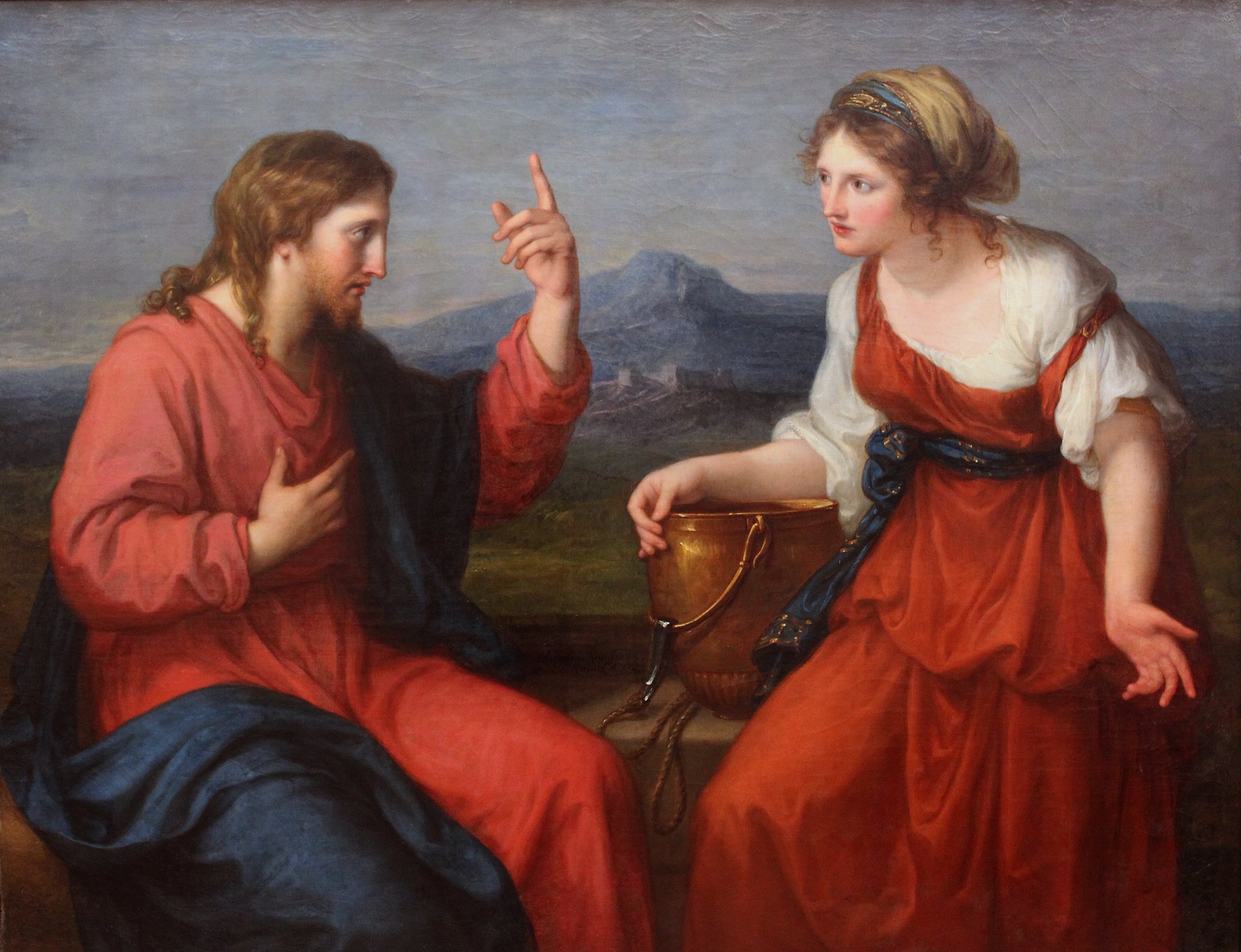
In today’s Gospel, the Samaritan woman is also exhausted. She goes to the well at noon, when she’s unlikely to see anyone else. She’s deliberately avoiding people because she’s socially exhausted. But after five husbands, she’s morally exhausted, too. And she’s spiritually exhausted – confused about God and her own identity.

And sitting there at the well is Jesus, who is tired from his own travels.

This is a powerful scene, for it tells us that God understands human suffering. Even Jesus gets tired and thirsty.

But why is he sitting at this well? Because that’s where the woman is. God is always there when we need him; he always has graces to share.

The Samaritan woman’s exhaustion becomes the crack through which God enters her life. But note that she doesn’t hide her story from Jesus. She simply tells the truth about herself, and Jesus responds by offering her living water – the joy, the hope and the fresh start she didn’t think was possible.

According to Eastern tradition, this woman was St Photina, the first evangelist in John’s Gospel. If you go to Nablus in the Holy Land today, you’ll find Jacob’s Well inside the Orthodox Church of St Photina. This is where she found Jesus’ living water.

Through the ages, countless people have found that God’s grace flows when their hearts are really struggling.

As St Paul says in today’s second reading, ‘Hope is not deceptive, because God’s love has been poured into our hearts.’

Mother Teresa experienced this herself. She suffered almost five decades of spiritual dryness, a deep interior exhaustion she called ‘the dark night of the poor.’ And yet, even when she felt empty, she kept on serving.

She once prayed, ‘Jesus, I have no words. Please speak through me. I have no strength. Please act through me.’ And that’s just what happened. God met her in her dryness, and gave her the living water she needed to keep going.

Towards the end of his life, St John Paul II was also exhausted. His Parkinson’s disease left him shaking and weak. Yet he continued working, saying, ‘I continue because that is my cross. And Christ did not come down from his.’

His exhaustion became a sacrament of perseverance. Just as the woman at the well drew strength from Jesus, so did John Paul II. When his strength was gone, Christ became his strength.

St Ann Elizabeth Seton

St Elizabeth Ann Seton, too, was a New York mother of five children. She was widowed at 29, ostracised by her community and exhausted from poverty and grief. She prayed, ‘My God, I am yours. Only show me the path, even if I can only take one step today.’

Jesus met her in her exhaustion and gave her new hope and direction. She went on to establish the first Catholic schools and first Catholic orphanage in the USA, as well as the first American congregation of religious sisters. 

Today, then, is a day for the exhausted, for the parent running on fumes, for the struggling carer and for anyone else who feels they have nothing left to give.

The good news is that with Jesus, the end of the rope is not the end; it’s the beginning. The moment when our strength gives way is precisely the place where God waits for us with his graces.

As we learnt from today’s readings, the Israelites’ exhaustion becomes the place where water gushes forth. The woman’s exhaustion becomes the moment she discovers her dignity. Moses’ exhaustion becomes a moment of divine action. And Jesus’ own exhaustion becomes a moment of encounter.

Sometimes the best prayer you can pray is simply: ‘Jesus, please come to me. I can’t do it without you.’

If you’re struggling and need living water, Jesus is waiting for you.