

Exhaustion
(Ex.17:3-7; Rom.5:1-2,5-8; Jn.4:5-42)
We all suffer from exhaustion from time to time. It can happen suddenly, perhaps through a crisis. And sometimes it arrives slowly, like a grinding weariness that grows over time.
We have all, at some point, thought: ‘I can’t take much more of this.’
In today’s first reading, the Israelites are exhausted. After wandering through the desert, they’re thirsty, they’re tired and their faith is fraying. ‘Is the Lord with us or not?’ they ask.
Moses is struggling, too. ‘Lord, what am I to do with this people?’ he asks. Like so many people today, he is worn out and has nothing left to give.
But note how God responds. He doesn’t wait until they’ve all calmed down, or until their problems are sorted. He meets them where they are and sends fresh water pouring from a rock.
New hope flows from the most unlikely place.
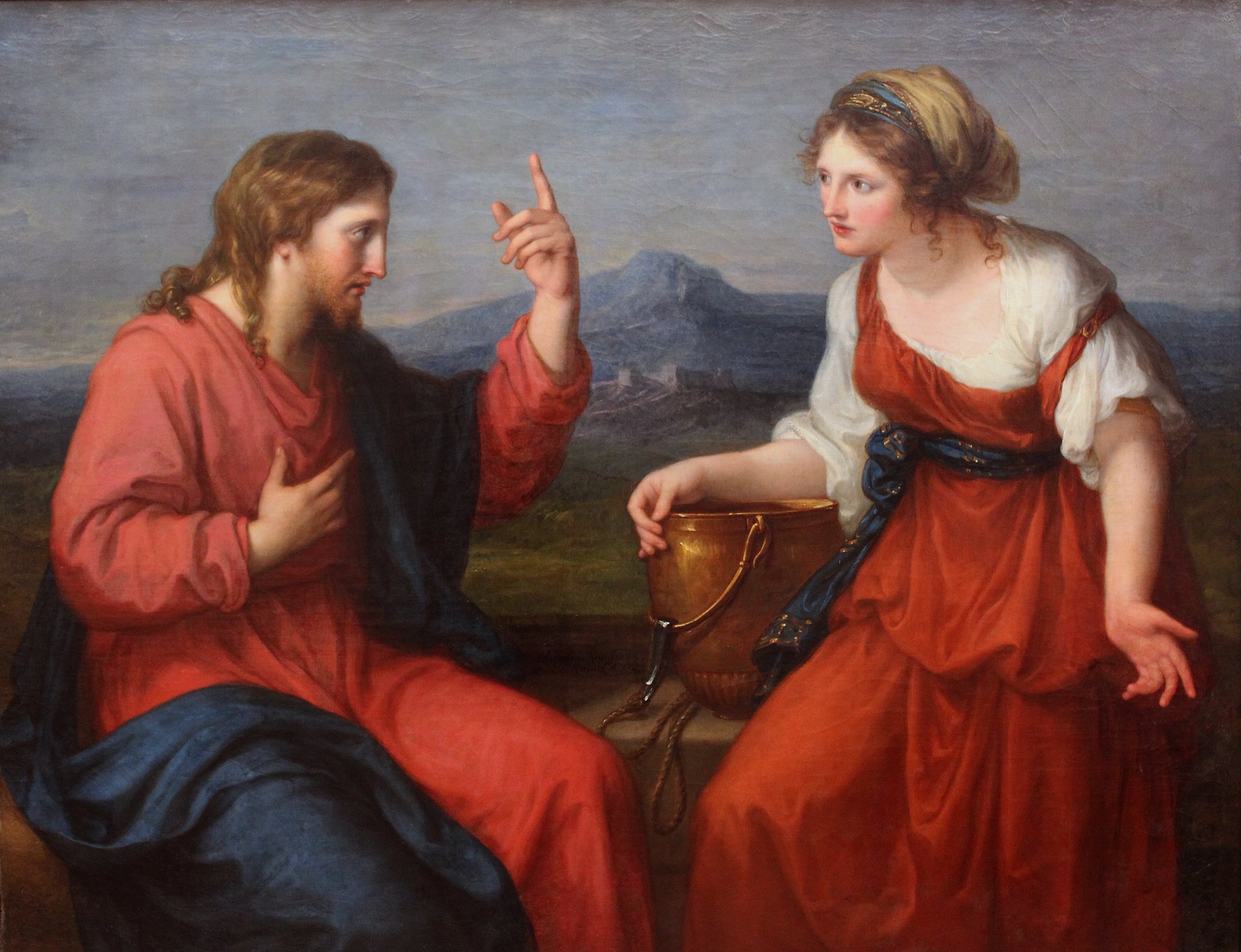

In today’s Gospel, the Samaritan woman is also exhausted. She goes to the well at noon, when she’s unlikely to see anyone else. She’s deliberately avoiding people because she’s socially exhausted. But after five husbands, she’s morally exhausted, too. And she’s spiritually exhausted – confused about God and her own identity.
And sitting there at the well is Jesus, who is tired from his own travels.
This is a powerful scene, for it tells us that God understands human suffering. Even Jesus gets tired and thirsty.
But why is he sitting at this well? Because that’s where the woman is. God is always there when we need him; he always has graces to share.
The Samaritan woman’s exhaustion becomes the crack through which God enters her life. But note that she doesn’t hide her story from Jesus. She simply tells the truth about herself, and Jesus responds by offering her living water – the joy, the hope and the fresh start she didn’t think was possible.

According to Eastern tradition, this woman was St Photina, the first evangelist in John’s Gospel. If you go to Nablus in the Holy Land today, you’ll find Jacob’s Well inside the Orthodox Church of St Photina. This is where she found Jesus’ living water.

Through the ages, countless people have found that God’s grace flows when their hearts are really struggling.
As St Paul says in today’s second reading, ‘Hope is not deceptive, because God’s love has been poured into our hearts.’
Mother Teresa experienced this herself. She suffered almost five decades of spiritual dryness, a deep interior exhaustion she called ‘the dark night of the poor.’ And yet, even when she felt empty, she kept on serving.
She once prayed, ‘Jesus, I have no words. Please speak through me. I have no strength. Please act through me.’ And that’s just what happened. God met her in her dryness, and gave her the living water she needed to keep going.
Towards the end of his life, St John Paul II was also exhausted. His Parkinson’s disease left him shaking and weak. Yet he continued working, saying, ‘I continue because that is my cross. And Christ did not come down from his.’
His exhaustion became a sacrament of perseverance. Just as the woman at the well drew strength from Jesus, so did John Paul II. When his strength was gone, Christ became his strength.

St Elizabeth Ann Seton, too, was a New York mother of five children. She was widowed at 29, ostracised by her community and exhausted from poverty and grief. She prayed, ‘My God, I am yours. Only show me the path, even if I can only take one step today.’
Jesus met her in her exhaustion and gave her new hope and direction. She went on to establish the first Catholic schools and first Catholic orphanage in the USA, as well as the first American congregation of religious sisters.
Today, then, is a day for the exhausted, for the parent running on fumes, for the struggling carer and for anyone else who feels they have nothing left to give.
The good news is that with Jesus, the end of the rope is not the end; it’s the beginning. The moment when our strength gives way is precisely the place where God waits for us with his graces.
As we learnt from today’s readings, the Israelites’ exhaustion becomes the place where water gushes forth. The woman’s exhaustion becomes the moment she discovers her dignity. Moses’ exhaustion becomes a moment of divine action. And Jesus’ own exhaustion becomes a moment of encounter.
Sometimes the best prayer you can pray is simply: ‘Jesus, please come to me. I can’t do it without you.’
If you’re struggling and need living water, Jesus is waiting for you.